Understanding How Rideshare Coverage Changes From Log-In to Drop-Off in Washington
Key Takeaways: Washington law under RCW 46.72B.180 sets insurance requirements that vary based on driver activity at the time of a crash. Period 1 begins when the driver logs in and waits for a request, requiring liability limits of at least $50,000 per person and $100,000 per accident for bodily injury and $30,000 for property damage, plus UIM and PIP to the extent required by Washington’s insurance code. Once a ride request is accepted, the prearranged ride begins, triggering a $1,000,000 combined single limit plus PIP that continues until the last passenger exits. While a passenger is in the vehicle, the policy must also provide $100,000/$300,000 underinsured motorist coverage. Insurers may exclude coverage under a driver’s personal auto policy for rideshare activity, and if the required policy does not provide coverage, the commercial transportation services provider must cover the claim from the first dollar. Because insurers often dispute app status and timing, trip logs, GPS data, and timestamps frequently determine which coverage tier applies.
Washington’s rideshare insurance requirements track what the driver was doing at the moment of the crash: logged in and waiting (Period 1), en route to pick up a passenger after accepting a ride (Period 2), and carrying a passenger during a prearranged ride (Period 3). The statute sets two liability tiers, with Periods 2 and 3 both falling within the “prearranged ride” period, and additional UIM required only while a passenger is aboard.
If you were hurt in an Uber or Lyft collision, the coverage analysis should not fall on your shoulders alone. The team at Telaré Law helps injured people in the Tri-Cities sort through layered rideshare policies and pursue the compensation Washington law allows. Call 509-736-3160 or schedule a free consultation to discuss your situation.
Why Washington Requires a Special Policy Before the App Ever Turns On
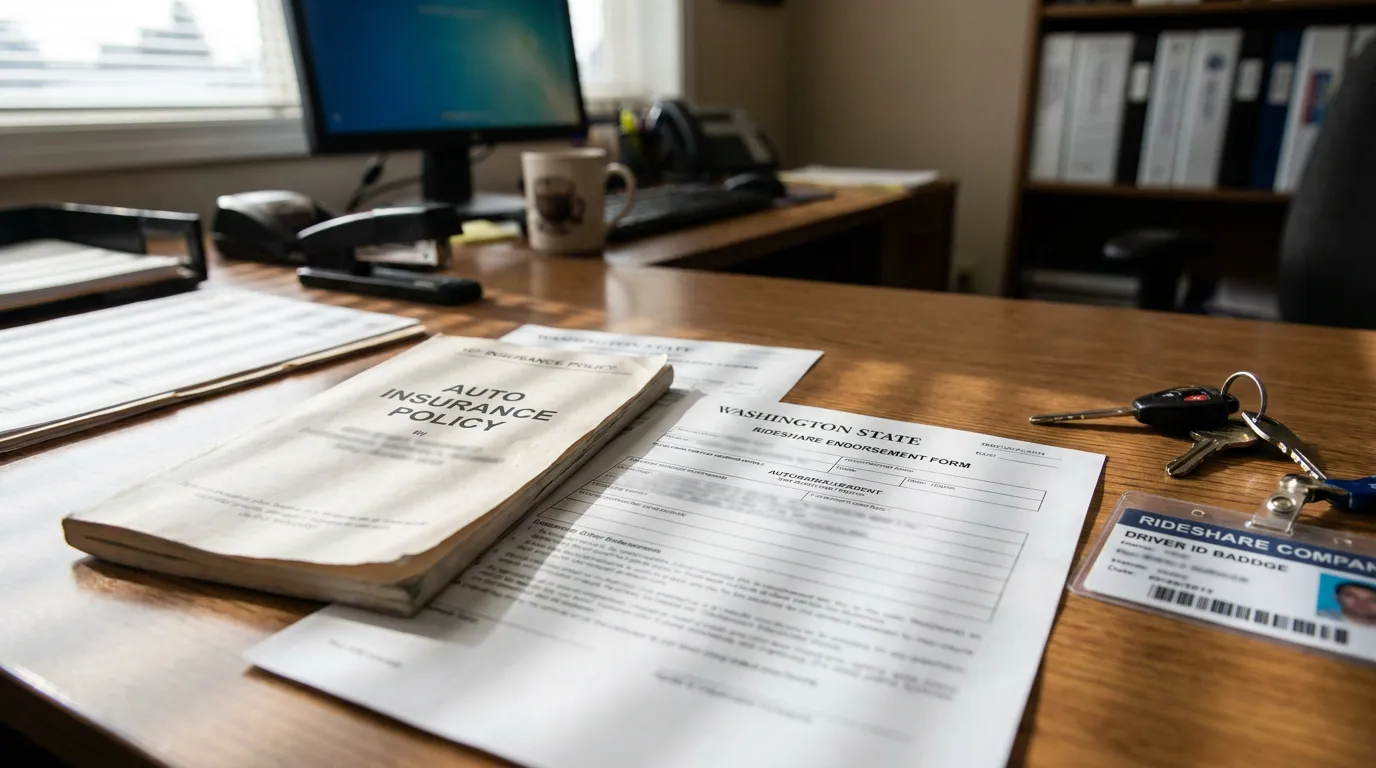
Washington’s framework requires coverage before a single ride is accepted. Under RCW 46.72B.180(1)(a), every personal vehicle used to provide commercial transportation services must be covered by a primary automobile insurance policy that specifically covers commercial transportation services, not a private passenger policy. This distinction explains why RCW 46.72B.180(6) allows insurers to exclude any coverage under a personal auto policy for losses occurring while a driver is logged in or providing a prearranged ride.
The legislature built this rule into Chapter 46.72B RCW, the same chapter that governs driver eligibility. Under RCW 46.72B.180(4), before allowing a person to provide commercial transportation services as a driver, a commercial transportation services provider must provide written proof to the driver that the driver is covered by a primary automobile insurance policy that meets the requirements of that section. You can review the full text of the Washington rideshare insurance statute directly through the state legislature’s website.
There is also an alternative compliance path. RCW 46.72B.180(1)(a) provides that requirements are alternatively satisfied by securing coverage pursuant to chapter 46.72 or 46.72A RCW that covers the vehicle twenty-four hours per day, seven days per week. In those cases, a driver may carry continuous for-hire coverage rather than the tiered structure.
Breaking Down the RCW 46.72B.180 Rideshare Insurance Periods
The statute sets different minimum limits depending on where the driver was in the trip cycle. Below is a comparison of the TNC insurance tiers Washington requires.
| Stage | Driver Status | Minimum Coverage Under RCW 46.72B.180 |
|---|---|---|
| Period 1 | Logged in, no ride accepted | $50,000 per person bodily injury; $100,000 per accident; $30,000 property damage; plus UIM and PIP to the extent required by RCW 48.22.030, 48.22.085, and 48.22.095 |
| Period 2 | Ride accepted, en route to passenger | $1,000,000 combined single limit; plus PIP to the extent required |
| Period 3 | Passenger in the vehicle | $1,000,000 combined single limit; plus PIP to the extent required; plus $100,000/$300,000 UIM |
Period 1: App On, Waiting for a Ride Request
Period 1 begins when the driver logs in and lasts until a ride request is accepted. Under RCW 46.72B.180(1)(b)(i), coverage during this period must include liability of at least $50,000 per person for bodily injury, $100,000 per accident, and $30,000 for property damage, along with underinsured motorist coverage and personal injury protection to the extent required by statute. Because UIM and PIP statutes permit a named insured to reject coverage in writing, they are not guaranteed on every policy.
Period 2: Ride Accepted and En Route to Pick Up
Period 2 covers the window after a driver accepts a trip and drives toward the passenger, which is part of the statutory “prearranged ride” period. Under RCW 46.72B.180(1)(b)(ii), coverage during a prearranged ride must include a combined single limit of $1,000,000 for death, personal injury, and property damage, plus PIP coverage to the extent required. The jump from Period 1 limits to a seven-figure combined single limit reflects the greater risk once a commercial trip is underway.
Period 3: Passenger Onboard Until Drop-Off
Period 3 applies while the passenger is physically in the vehicle. The same $1,000,000 combined single limit continues because the prearranged ride is still in progress, and Washington adds passenger-specific protection. Under RCW 46.72B.180(1)(b)(iii), the policy must provide underinsured motorist coverage of $100,000 per person and $300,000 per accident from the moment a passenger enters until they exit. That UIM layer can matter significantly when the at-fault party carries minimal insurance.
What Happens When the Driver’s Policy Does Not Respond
Washington anticipated scenarios where a driver’s required policy has lapsed. Under RCW 46.72B.180(2)(b), if the primary policy maintained by the driver does not provide coverage for any reason, including that the policy lapsed or did not exist, the commercial transportation services provider must provide the required coverage beginning with the first dollar of the claim.
That protection is not self-executing, however. Insurers may dispute whether the app was on, when the ride was accepted, or whether the driver was engaged in a prearranged ride at impact. These are fact-dependent questions that turn on evidence such as trip logs, GPS records, timestamps, and the driver’s account. Additional context on driver classification is available through the state’s overview of TNC driver rights.
💡 Pro Tip: If you can safely do so at the scene, photograph the driver’s phone screen showing the active trip or ride status. That single image may later help corroborate which insurance period applied.
Practical Steps After an Uber or Lyft Crash in the Tri-Cities
Documentation drives rideshare claim coverage disputes. Consider these steps, subject to your safety and medical needs:
- Request a copy of the trip receipt or ride history from your rideshare app account
- Seek prompt medical evaluation, since delayed treatment is frequently used to challenge causation
- Report the collision through the app and to law enforcement
- Preserve names and contact information for the driver, passengers, and witnesses
- Avoid recorded statements to any insurer before understanding which policy layers apply
Claims involving catastrophic injuries deserve particular care. Traumatic brain injuries, spinal cord damage, and amputations often generate lifetime care needs that may far exceed an initial settlement offer. Proving the full scope of damages may require medical records, treating physician testimony, life care planning, and accident reconstruction. An experienced rideshare accident lawyer can help evaluate whether available limits match the true value of the harm.
Common Complications in Washington Rideshare Claims
Multiple policies do not always mean simple recovery. In many cases, several insurers each argue that a different policy sits in the primary position, which can slow the process considerably. Comparative fault, multiple injured claimants sharing a single limit, and disputes over whether the driver was logged in all add complexity.
Timing issues also deserve attention. Washington’s civil statutes of limitations govern how long an injured person has to file a lawsuit. Most personal injury claims are subject to a three-year deadline under RCW 4.16.080, with narrow exceptions such as tolling or discovery rules. Our car accident legal insights address related deadline and liability questions in more detail.
💡 Pro Tip: Do not assume the highest limit applies simply because a rideshare vehicle was involved. A crash occurring seconds before ride acceptance may fall under Period 1 limits instead.
Frequently Asked Questions
1. Does a driver’s personal auto policy cover a rideshare crash?
Often it does not. RCW 46.72B.180(1)(a) states that the required primary policy is not a private passenger policy, and RCW 46.72B.180(6) expressly allows insurers to exclude personal policy coverage while a driver is logged in or providing a prearranged ride.
2. What if the at-fault driver was not the Uber or Lyft driver?
If another motorist caused the crash while you were a passenger, that driver’s liability coverage generally responds first. If those limits are inadequate, the $100,000 per person and $300,000 per accident underinsured motorist coverage required under RCW 46.72B.180(1)(b)(iii) may become relevant, along with any UIM coverage of your own.
3. Do the Uber insurance periods apply to pedestrians and other drivers?
Yes, as to liability coverage. The statutory limits govern the policy itself, not the claimant’s identity, so pedestrians, cyclists, and occupants of other vehicles may pursue liability claims against the applicable coverage depending on the period involved, although passenger-specific UIM applies only while a passenger is in the vehicle.
4. How is the correct period determined after a collision?
Coverage typically depends on app data, including log-in status, ride acceptance timestamps, and GPS records. Because these records are controlled by the transportation network company, prompt preservation requests are often important.
5. What if the driver had 24/7 commercial coverage instead?
Some drivers satisfy requirements through continuous for-hire or commercial coverage under chapter 46.72 or 46.72A RCW, as RCW 46.72B.180(1)(a) permits. In those situations, the tiered period analysis may be replaced by a single continuous policy.
Bringing the Coverage Picture Into Focus
Washington rideshare law creates a layered system in which available insurance can shift dramatically from one minute to the next. Period 1 carries modest liability limits, while Periods 2 and 3 trigger a $1,000,000 combined single limit, with Period 3 adding dedicated underinsured motorist protection for passengers. Because every claim depends on its own facts, including who was at fault, what the app data shows, actual policy language, and injury severity, no general article can substitute for a careful review of your specific circumstances.
You do not have to untangle the RCW 46.72B.180 rideshare insurance periods on your own. Reach out to Telaré Law today or call 509-736-3160 to speak with the Richland injury attorneys about your rideshare collision and the coverage that may apply.
Disclaimer: This content is for informational purposes only and is not legal advice. Every case is unique, and results may vary. Consult an attorney about your specific circumstances.