Why Your Repaired Car May Still Be Worth Less After a Richland Crash
Key Takeaways: A diminished value claim seeks the market value your vehicle permanently lost because it now carries an accident history, even after flawless repairs. The most common form is inherent diminished value, while repair-related loss stems from poor workmanship, and frame or structural damage often deepens the loss by disqualifying a car from certified pre-owned resale. These claims are typically filed as third-party claims against the at-fault driver’s insurer, since many policies exclude diminished value coverage. Because the claim sounds in tort, the vehicle’s legal owner carries the burden of proof and typically needs a repair invoice, vehicle history reports, comparable listings, and an independent USPAP-compliant appraisal. Washington’s pure comparative fault rule under RCW 4.22.005 reduces recovery by your percentage of fault rather than barring it, and statutory minimum limits, deductibles, and filing deadlines all shape the net result. Careful documentation and reviewing any property damage release before signing are essential to protecting your claim.
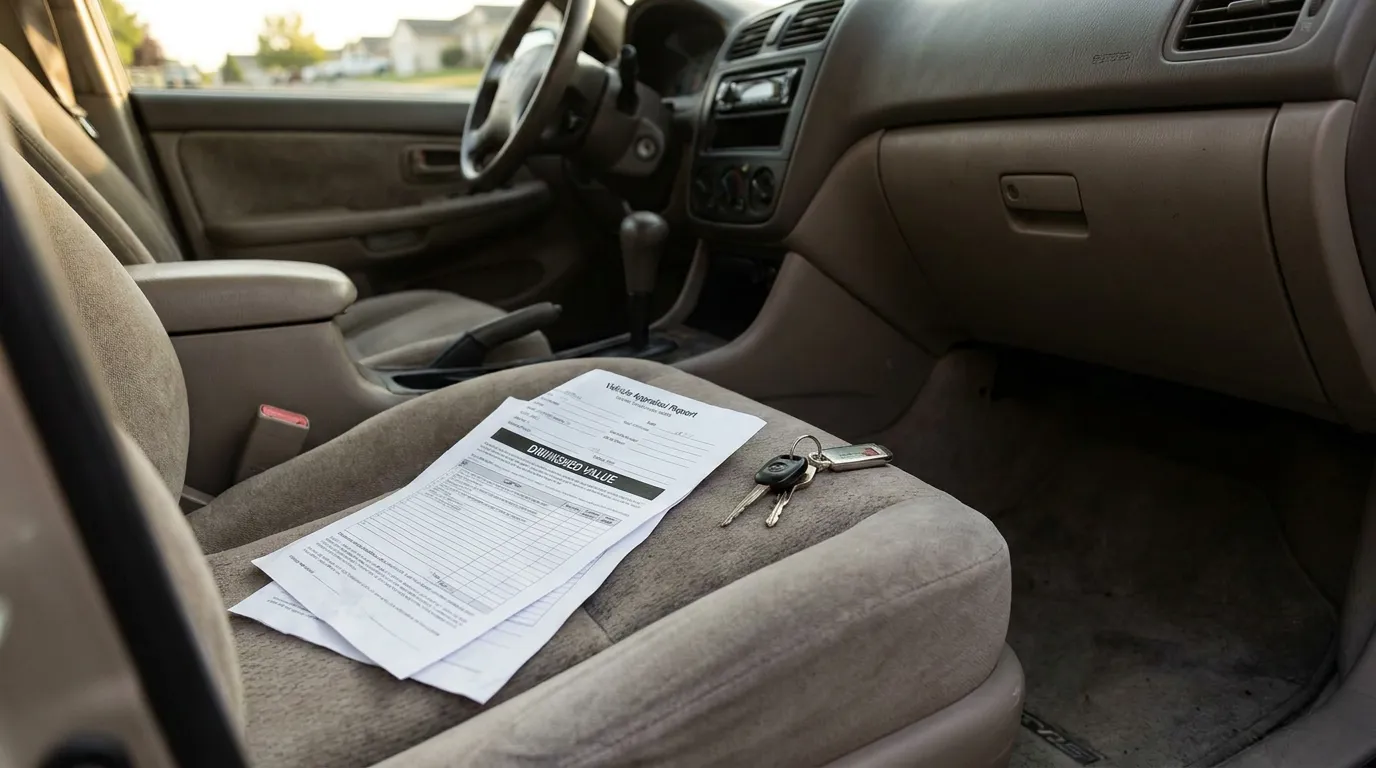
Your car may look factory-fresh after body shop repairs, but its market value may not return. That gap is the heart of a diminished value claim: the loss in a vehicle’s market value after it was damaged and repaired. Washington’s insurance regulator describes it as the difference between your car’s pre-accident market value and its post-repair market value. This loss can run into thousands of dollars, and it may be compensable property damage that a settlement check covering repairs alone doesn’t fully restore.
If you were hurt or your vehicle was damaged in a Tri-Cities collision, the team at Telaré Law can help you evaluate whether post-repair value loss belongs in your claim. Call 509-736-3160 or contact us now to discuss your situation with a Richland car accident attorney.
The Diminished Value Definition Every Washington Driver Should Know
Diminished value is the economic loss that survives the repair process. Repairs restore function and appearance, but the vehicle history record generally doesn’t disappear. Once a collision is reported to CARFAX or AutoCheck, buyers and dealers may discount the vehicle, and that discount can be the measurable loss you may pursue.
Two forms of this loss dominate real-world claims. Understanding which applies to your vehicle shapes the evidence you’ll need.
Inherent Diminished Value
Inherent diminished value is the loss that remains even after proper, high-quality repairs. Many collision-involved vehicles suffer some degree of it because the accident history is generally permanent. This is the category most Richland claimants pursue, though whether a measurable loss exists depends on proof rather than assumption.
Repair-Related Diminished Value
Repair-related diminished value stems from poor-quality or incomplete repair work. This category is comparatively rare but can arise when a shop uses mismatched panels, leaves paint defects, or fails to restore factory tolerances. Proving it usually requires documentation from a second qualified shop or independent inspector. A claim for faulty workmanship may also lie against the repair facility rather than an insurer.
Why Structural Damage Multiplies the Loss
Frame or structural damage can sharply increase car value loss after an accident. Vehicles with frame damage often cannot be resold as certified pre-owned under many manufacturer programs, removing them from a large, higher-priced segment of the used market. If your repair estimate references frame straightening, unibody sectioning, or structural welds, your resale value loss claim may be substantial.
How a Diminished Value Claim Washington Drivers File Actually Works
Most claims are third-party claims filed against the at-fault driver’s insurer rather than your own policy. The state regulator’s guidance on filing an auto insurance claim explains that you’ll typically file against the at-fault party’s insurer, and notes that some auto policies do not cover diminished value at all. Third-party diminished value claims are recognized in nearly every state, and Washington drivers may generally pursue them, although recovery depends on state law and the facts of the claim.
The legal foundation sits in tort law, which means the vehicle owner carries the burden of proof. Payment is not automatic. The insurer may test your evidence, and typically only the party holding the ownership interest may collect, which matters if the car is leased or titled to a family member.
| Claim Type | Filed Against | Typical Basis |
|---|---|---|
| Third-party | At-fault driver’s liability insurer | Tort liability for property damage |
| First-party | Your own insurer | Contract terms of your policy, if covered |
💡 Pro Tip: Before signing any property damage release, read it carefully. A broad release may close your ability to pursue a washington vehicle depreciation claim later, even if you haven’t yet obtained an appraisal.
Washington Statutes That Shape Auto Accident Property Damage Recovery
Washington law sets baseline liability coverage for property damage claims. Under RCW 46.29.490(2), an owner’s liability policy must insure against damages arising from vehicle ownership, maintenance, or use, subject to a $10,000 limit for property damage in any one accident. Because diminished value may be treated as property damage loss, those minimum limits can define the coverage ceiling from a minimally insured driver, though many carry higher limits and an at-fault driver may remain personally liable for amounts above the policy limit.
Coverage involving underinsured and hit-and-run drivers follows a separate statutory track. The underinsured motorist property damage statute, RCW 48.22.030(7), permits a deductible of not more than $300 for property damage caused by a hit-and-run driver or phantom vehicle, and not more than $100 in other cases. UIM property damage coverage is optional and may be rejected in writing, so whether it applies depends on your policy.
Partial fault generally reduces but doesn’t eliminate recovery. Washington applies pure comparative fault under RCW 4.22.005, which provides that contributory fault diminishes proportionately the amount awarded as compensatory damages but doesn’t bar recovery. A Richland driver found 25 percent at fault may still pursue a diminished value claim, reduced by that percentage. Adjusters sometimes assign fault percentages aggressively, and those assignments may be negotiable or contested.
Proving Post-Repair Value Loss With Credible Evidence
Documentation drives the outcome of a resale value loss claim far more than argument does. State guidance confirms the insurer doesn’t automatically pay, that the claim requires proof, and that owners may either self-document the loss or hire a private appraisal company. An independent, USPAP-compliant appraisal is commonly used as proof because it applies recognized valuation standards rather than an insurer’s internal formula, though no particular appraisal form is legally required and insurers may challenge it.
Practical evidence that may strengthen a claim includes:
- Complete repair invoice showing scope of work, including structural repairs
- Pre-accident and post-repair vehicle history reports
- Independent appraisal from a qualified vehicle appraiser
- Comparable listings for similar vehicles with and without accident history
- Photographs of damage before repairs began
Insurers may dispute your appraiser’s methodology, comparables, or fault allocation. State guidance acknowledges you could need legal advice. Anyone weighing whether the disputed amount justifies further action should calculate your damages across the full claim, including injury losses, rather than viewing the vehicle in isolation.
💡 Pro Tip: Request a copy of the body shop’s supplemental estimates, not just the final invoice. Supplements often reveal hidden structural damage discovered mid-repair, which supports a higher valuation.
Deadlines, Deductibles, and Other Traps in a Richland Crash Claim
The time available to recover depends on which statute of limitations applies. In Washington, actions for injury to personal property are generally subject to a three-year limitations period under RCW 4.16.080, while claims on a written contract such as an insurance policy are generally governed by a six-year period under RCW 4.16.040, and policies may contain their own suit-limitation provisions. These periods are applied strictly, and courts often interpret tolling and discovery-rule exceptions narrowly. Confirming the deadline early with counsel is prudent.
Your policy generally governs how quickly you must notify your insurer. State guidance explains that filing time varies based on your policy and insurance company, and advises keeping receipts for roadside service expenses such as towing. Protect the vehicle from further damage while the claim is pending, since additional deterioration can complicate valuation.
Your deductible is a separate recovery issue worth tracking. When your own insurer subrogates against the at-fault party, Washington regulations generally require it to include your deductible in its subrogation demand and share any recovery on a proportionate basis. If you were partially at fault, you may recover only a percentage of it.
Frequently Asked Questions
1. Can I file a diminished value claim if I was partly at fault for the crash?
In many cases, yes. Washington’s pure comparative fault rule reduces compensatory damages in proportion to your share of fault rather than barring recovery. The practical effect depends on how fault is ultimately apportioned, which is often disputed.
2. Does my own insurance cover post-repair value loss?
It depends on your policy language. Some auto insurance policies do not cover diminished value, and many first-party policies limit the insurer’s obligation to the cost of repair or replacement, which is why these claims are often directed at the at-fault party’s insurer.
3. How much is my washington vehicle depreciation claim worth?
There is no fixed formula. Value may turn on the vehicle’s age, mileage, pre-accident condition, damage severity, and whether structural components were affected. An independent appraisal generally provides a more defensible figure, but doesn’t guarantee any particular outcome.
4. Who is legally entitled to collect the payment?
Generally, the party holding the ownership interest in the vehicle. Leased vehicles and vehicles titled to another person or entity typically require careful review of title and lease documents before a claim is submitted.
5. What if the insurer simply refuses to engage?
Consumers with disputed claim-handling issues may contact the Washington Office of the Insurance Commissioner’s Consumer Advocacy line at 800-562-6900, available 8:30 a.m. to 4:30 p.m. Monday through Friday. That regulatory process is separate from any civil lawsuit, doesn’t extend any legal deadline, and doesn’t substitute for one.
Protecting the Full Value of Your Claim
A repaired vehicle with an accident on its record may be worth less, and Washington law may recognize that loss as compensable property damage where it is proven. Outcomes depend on credible valuation evidence, accurate fault analysis under RCW 4.22.005, and attention to statutory limits and deductibles that shape net recovery. Working with a diminished value claim Washington lawyer can help you present the loss in a form insurers take seriously.
Don’t let an adjuster decide unilaterally what your vehicle lost. Reach out to Telaré Law by calling 509-736-3160 or schedule your consultation to discuss your Richland auto accident today.
Disclaimer: This content is for informational purposes only and is not legal advice. Every case is unique, and results may vary. Consult an attorney about your specific circumstances.