How the MCS-90 Endorsement Protects Truck Accident Victims in Richland, WA
If you or a loved one suffered injuries in a semi-truck collision in Richland, Washington, you may have heard the term “MCS-90 endorsement” without fully understanding what it means for your claim. The MCS-90 is a federal insurance endorsement required by the Federal Motor Carrier Safety Administration (FMCSA) for for-hire motor carriers operating in interstate or foreign commerce. Its purpose is to guarantee that injured members of the public can access compensation from a carrier’s insurance policy, even when the insurer might otherwise rely on policy exclusions to deny a claim. For families facing catastrophic injuries, mounting medical bills, and lost income, understanding this endorsement can mean the difference between fair compensation and a dead end.
If you need guidance after a serious truck collision, Telaré Law is ready to help. Call 509-736-3160 or reach out online to discuss your case.
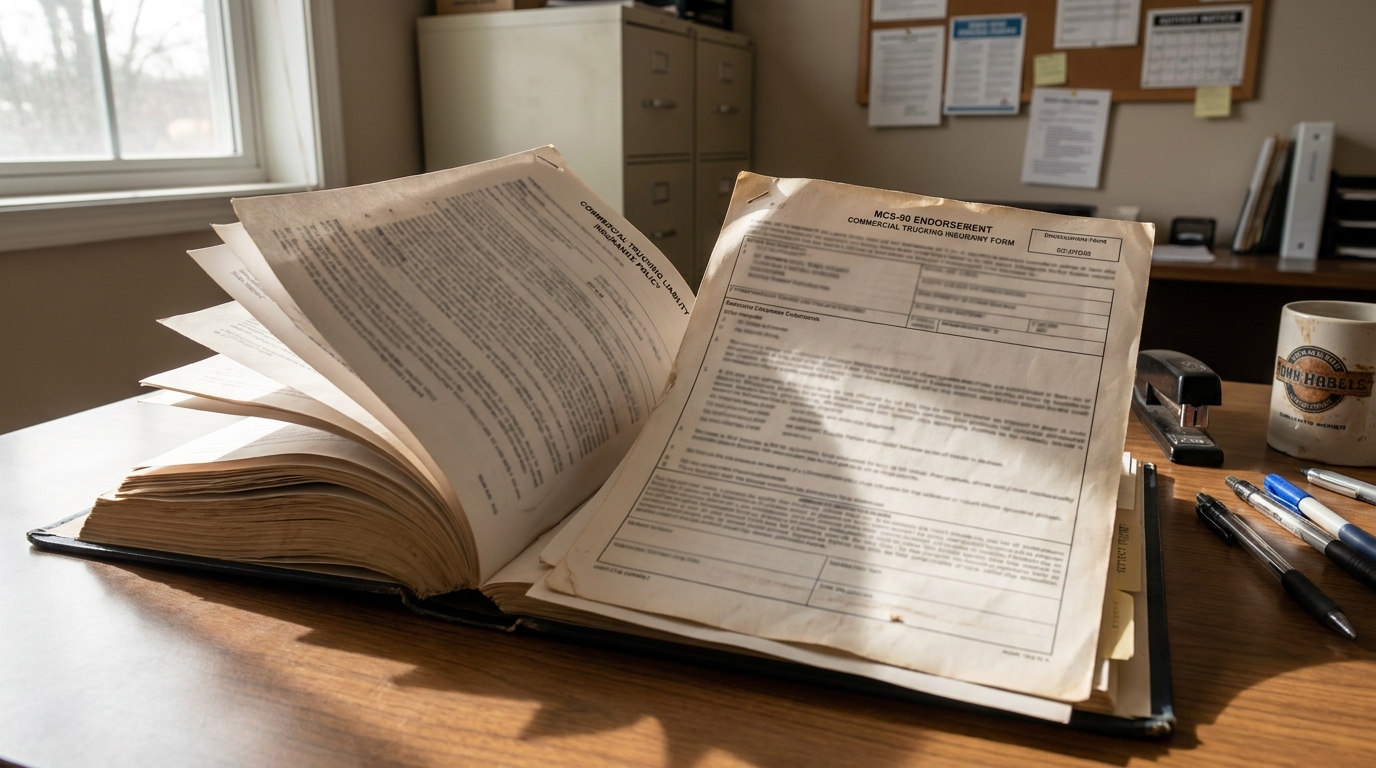
What Is the MCS-90 Endorsement Under Federal Law?
The MCS-90 endorsement is a mandatory attachment to liability insurance policies carried by for-hire motor carriers operating in interstate or foreign commerce under FMCSA authority. Under 49 CFR 387.15, the FMCSA requires such carriers to file either an MCS-90 Endorsement for Policies of Insurance or an MCS-82 Endorsement for Surety Bonds. The FMCSA will not grant operating authority until the registrant has minimum financial responsibility on file.
The endorsement functions as a safety net for the public, not the carrier. Under 49 CFR 387.5, the “insured and principal” on the MCS-90 form is the motor carrier named in the policy plus its fiduciary. The FMCSA has clarified that the MCS-90 does not require a motor carrier’s insurer to satisfy a judgment against any party other than the named carrier or its fiduciary. For injured victims in Richland, this means the endorsement targets the carrier’s insurance obligation, ensuring policy loopholes do not eliminate recovery. The MCS-90 functions as a guaranty, and the insurer may seek reimbursement from the motor carrier after paying a covered judgment.
💡 Pro Tip: After a semi-truck crash, ask your attorney to verify the at-fault carrier’s FMCSA registration and insurance filing requirements early in the case. Confirming an MCS-90 endorsement is on file can reveal coverage not obvious from the police report.
Federal Trucking Insurance Requirements and Minimum Coverage Amounts
The amount of insurance a motor carrier must maintain depends on the type of freight it hauls and the gross vehicle weight rating (GVWR) of its trucks. Federal law under 49 CFR 387.9 sets specific minimum thresholds carriers must meet before operating. These minimums define the baseline coverage available to compensate you for medical expenses, lost wages, pain and suffering, and other damages.
| Carrier Type | GVWR | Minimum Coverage |
|---|---|---|
| For-Hire Property Carriers (Non-Hazardous, Interstate/Foreign Commerce) | 10,001 lbs or more | $750,000 |
| Carriers of Oil, Hazardous Waste, or Certain Hazardous Materials | 10,001 lbs or more | $1,000,000 |
| Carriers of Explosives, Poison Gas, Highway-Route-Controlled Radioactive Materials, or Similar High-Risk Hazardous Substances | Any weight | $5,000,000 |
These are minimums, not caps. Many carriers purchase higher policy limits. When injuries are severe, identifying every available coverage source is critical. If medical bills threaten to exceed the carrier’s policy limits, understanding how medical bills can exceed policy limits becomes important to your claim strategy.
💡 Pro Tip: Do not assume a trucking company’s insurance is limited to the federal minimum. Your attorney can request the full policy declarations page to determine whether additional coverage, umbrella policies, or excess layers exist.
Why the MCS-90 Matters for a Semi-Truck Injury Claim in Washington
It Overrides Policy Exclusions That Could Deny Your Claim
One of the most powerful features of the MCS-90 endorsement is that it prevents insurers from using standard policy exclusions to avoid paying injured third parties. Under the MCS-90’s terms, the insurer agrees to pay any final judgment recovered against the insured motor carrier for bodily injury to or death of members of the public resulting from the negligent operation, maintenance, or use of covered motor vehicles, regardless of whether the underlying policy would otherwise exclude the loss. The MCS-90 operates as a federal guaranty. When triggered by an exclusion, the insurer pays the judgment but may then seek reimbursement from the motor carrier.
It Aligns With Washington’s Own Protections for Injury Victims
Washington state law independently reinforces many of the same protections the MCS-90 provides at the federal level. Under WA § 46.29.490(6)(a), once an injury or damage covered by a motor vehicle liability policy occurs, the insurer’s liability becomes absolute. The policy cannot be canceled or annulled by any agreement between the insurer and insured after the injury event, and no statement made by the insured defeats or voids the policy.
Washington law also confirms that the insured’s satisfaction of a judgment is not a prerequisite for the insurer’s duty to pay. Under WA § 46.29.490(6)(b), the satisfaction by the insured of a judgment for injury or damage is not a condition precedent to the insurance carrier’s right or duty to make payment. This protects truck accident victims from scenarios where the at-fault carrier lacks funds to pay a judgment.
💡 Pro Tip: If an insurance adjuster suggests the trucking company’s policy does not cover your specific loss, do not take that at face value. The MCS-90 endorsement and Washington law both limit an insurer’s ability to deny coverage to injured claimants.
How Washington State Law Supports Your Oregon Truck Accident Lawyer Strategy
CDL and FMCSA Regulatory Overlap in Washington
Washington’s commercial driver’s license framework is directly integrated with federal FMCSA regulations, reinforcing the applicability of federal insurance rules to carriers operating in Richland. Under WA § 46.25.075(2), CDL and CLP applicants and holders engaged in nonexcepted interstate, excepted interstate, or nonexcepted intrastate commerce must provide a medical examiner’s certificate prepared by a medical examiner as defined under 49 C.F.R. § 390.5. References to 49 C.F.R. Part 391 physical qualification standards appear in the separate RCW 46.25.055 provision. This regulatory overlap confirms that truck drivers on Richland roads are subject to both state and federal compliance obligations, including the MCS-90 endorsement requirement.
For-Hire Operators Must Carry Public Liability Insurance
Washington law separately requires for-hire motor vehicle operators to maintain public liability insurance covering every vehicle they operate. Under WA § 46.72.050, operators must maintain coverage assuring against property damage and personal liability to the public. This state-level mandate works alongside federal FMCSA requirements to provide injury victims with a viable insurance source. WA § 46.72.050 also preserves the right of any injured person to bring a private right of action against a for-hire operator.
💡 Pro Tip: Washington law under WA § 46.29.490(6)(d) establishes that an insurance policy and any attached endorsement that does not conflict with the chapter’s provisions constitutes the entire contract between the parties. This confirms the legal standing and enforceability of endorsements like the MCS-90 in Washington commercial truck insurance claims.
Building a Strong Commercial Truck Insurance Claim in Richland
A successful semi-truck injury case requires more than proving the other driver was at fault. You must also identify every source of insurance coverage, preserve critical evidence, and document the full scope of your current and future losses. The MCS-90 endorsement is one piece of a larger puzzle that may include:
- The carrier’s primary liability policy and any excess or umbrella coverage
- The trucking company’s FMCSA registration records and safety history
- Driver qualification files, hours-of-service logs, and maintenance records
- Medical documentation of injuries, treatment plan, and long-term care needs
- Evidence of lost earning capacity, pain and suffering, and loss of consortium
Time is critical in every truck accident case. Evidence can disappear quickly. Electronic logging device data may be overwritten, and witnesses’ memories fade. Washington’s statute of limitations governs how long you have to file a lawsuit. Acting promptly preserves your rights and strengthens your claim.
💡 Pro Tip: Request that your attorney send a spoliation letter to the trucking company and its insurer immediately after the crash. This formal notice demands preservation of all electronic data, maintenance logs, driver records, and dispatch communications related to the collision.
Frequently Asked Questions
1. Does the MCS-90 endorsement apply to all truck accidents in Richland, WA?
The MCS-90 endorsement applies to for-hire motor carriers required to register with the FMCSA and operating in interstate or foreign commerce. It generally does not apply to purely private, intrastate carriers below federal registration thresholds, though private carriers transporting certain hazardous materials may still be subject to FMCSA requirements. Whether it applies depends on the carrier’s operating authority and trip nature at the time of the crash. An experienced truck accident lawyer Richland WA can investigate the carrier’s FMCSA filings to determine applicability.
2. Can a trucking company’s insurer deny my claim because of a policy exclusion?
The MCS-90 endorsement significantly limits an insurer’s ability to use policy exclusions against injured third parties. When triggered, the insurer must pay the final judgment up to the federal minimum, but may then seek reimbursement from the motor carrier. Additionally, under WA § 46.29.490(6)(a), the insurer’s liability becomes absolute once the covered injury occurs. However, coverage disputes can still arise depending on specific facts and policy language.
3. What is the minimum insurance coverage a trucking company must carry?
Federal minimums range from $750,000 to $5,000,000, depending on cargo type and vehicle weight. For-hire carriers of non-hazardous freight with a GVWR of 10,001 pounds or more must carry at least $750,000. Carriers transporting oil or certain hazardous materials must carry at least $1,000,000. Carriers transporting explosives, poison gas, or highway-route-controlled radioactive materials must carry $5,000,000. Many carriers maintain coverage above these floors.
4. How does the MCS-90 endorsement help if the trucking company has no money to pay a judgment?
The MCS-90 endorsement ensures the carrier’s insurer remains responsible for paying covered claims to injured members of the public, up to the applicable federal minimum. Washington law under WA § 46.29.490(6)(b) reinforces this by establishing that the insured’s satisfaction of a judgment is not a condition precedent to the insurer’s duty to pay. Together, these protections help prevent an insolvent carrier from leaving you with an uncollectible judgment.
5. Should I hire an Oregon truck accident lawyer for a Richland truck crash?
Because Richland sits near the Oregon border, many truck accident cases involve carriers, routes, or parties crossing state lines. An oregon truck accident lawyer with knowledge of both Washington and federal trucking regulations can effectively handle multi-jurisdictional issues. What matters most is finding an attorney with extensive experience in FMCSA compliance, commercial insurance claims, and plaintiff-side truck injury litigation.
Protecting Your Rights After a Richland Semi-Truck Collision
The MCS-90 endorsement exists to protect people like you. It ensures that when a federally regulated truck causes serious harm, insurance coverage remains available regardless of the carrier’s attempts to hide behind policy defenses. Combined with Washington’s own strong protections for injury victims, this federal endorsement gives you a meaningful path to compensation for medical bills, lost income, pain and suffering, and long-term care needs.
Telaré Law is here to help families in Richland and throughout Southeast Washington facing the aftermath of a devastating truck crash. Call 509-736-3160 or contact us today to discuss your semi-truck injury claim.